


.png)


Google Told Us Budget-Limited Campaigns Would “Perform Closer to Target.” Here’s What We Actually See Happening in Our Ecommerce Accounts.
On August 17, 2026, Google implemented the first phase of their approach to change how Smart Bidding handles any Target ROAS or Target CPA campaign that is “Limited by budget.” The stated goal was predictability: campaigns that had been quietly over-delivering against their targets would start delivering at their targets, and advertisers could finally raise budgets without the wild performance swings we have all grown accustomed to.
Google’s own example was vague at best, even for the most seasoned pros. If your campaign had a $10 target CPA and was achieving $5, expect it to drift toward $10. Give up some efficiency, gain some scale. Fair trade.
The honest truth, that is not what we saw.
I also think it’s worth saying up front: as of early September, nobody that I trust in the industry has published post-rollout numbers from the change. The coverage we saw from June through mid-August was almost entirely “here’s what’s coming and how to prepare.” Google itself noted the rollout wasn’t complete until Aug 27, and most industry leaders have suggested the first reliable performance reads wouldn’t land until mid-September or later. We think the data is already pretty clear and needs to be shared.
Our agency manages paid search for a portfolio of ecommerce brands ranging from under $10K/month in Google spend to well over $1M. We pulled campaign-level data across those accounts, week over week from early August through the first week of September, and compared campaigns that were budget-limited on target-based bidding against everything else. The picture is becoming consistent enough that we think everyone running budget-capped tROAS or tCPA campaigns needs to see it.
The short version: budget-limited target campaigns did not get more volume at a worse target. They got less volume at a worse target. Same spend, a fraction of the clicks, and revenue that fell by half or more in the worst cases. And the smaller the account, the fewer places the damage had to hide in the account.
What we looked at
For every account we pulled four weeks of campaign data: two weeks before the change (weeks of Aug 3 and Aug 10) and two weeks after (weeks of Aug 17 and Aug 24). Aug 17 conveniently fell on a Monday, so the weekly breaks line up exactly with the rollout. For some of the hardest-hit accounts we also pulled daily data through Sep 4.
For each campaign we tracked spend, clicks, conversions, conversion value, bidding strategy, target, daily budget, and Search budget-lost impression share (the metric Google uses to flag a campaign as “Limited by budget”).
The logic: if the change did what Google said, budget-limited target campaigns should show roughly flat spend, roughly flat or higher clicks, and ROAS drifting toward target (if I am bidding towards a 3x, but hitting a 5, don’t be surprised if I start to hit closer to that 3x target now). Unconstrained campaigns and non-target strategies (You know, going old-school: Manual CPC, Target Impression Share, Maximize Conversions with no target) should be untouched.
The second half held. The first half did not.
Finding 1: Same money, a fraction of the traffic
The single most consistent pattern across affected campaigns was flat spend paired with a collapse in clicks. Google didn’t stop spending your budget. It just bought far less with it.
A ~$8K/month ecommerce account (Brand A), all target-based, all budget-limited. Whole-account daily numbers:
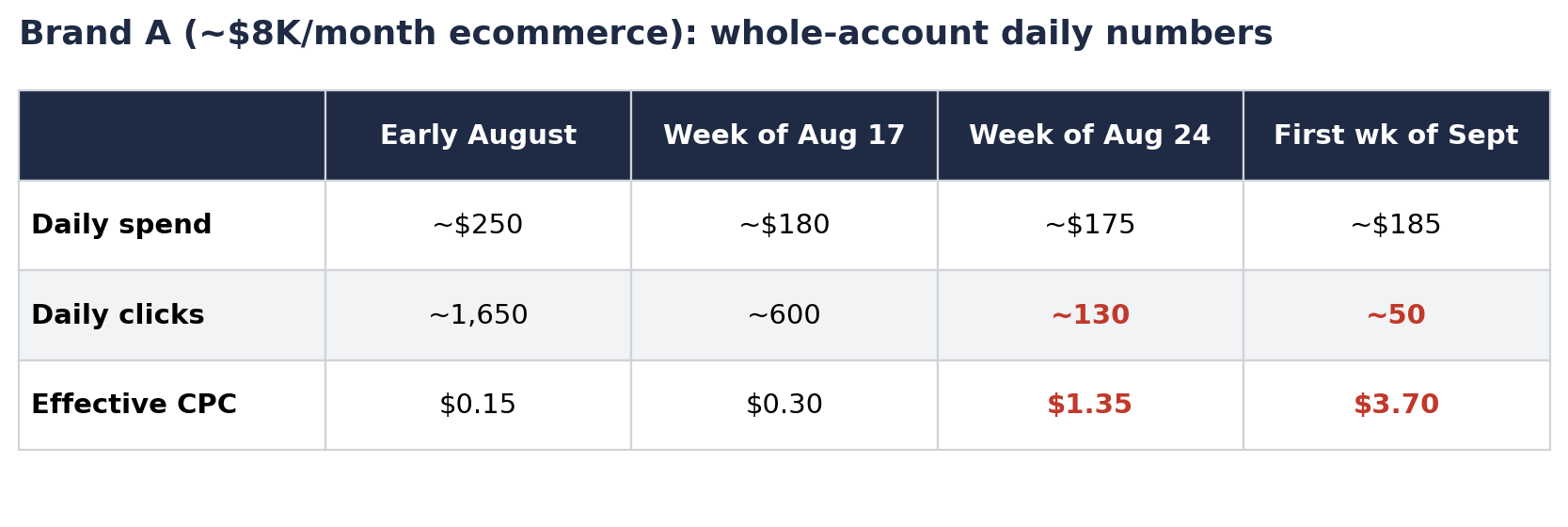
Its main Performance Max campaign (6x tROAS, $230/day budget) went from 4,880 clicks the week of Aug 3 to 1,683 the week of Aug 17 to 729 the week of Aug 24, at essentially the same weekly spend. Budget-lost impression share on that campaign went from 5% to 7% to 90%. Weekly conversion value went from roughly $31K to $10K to $6K.
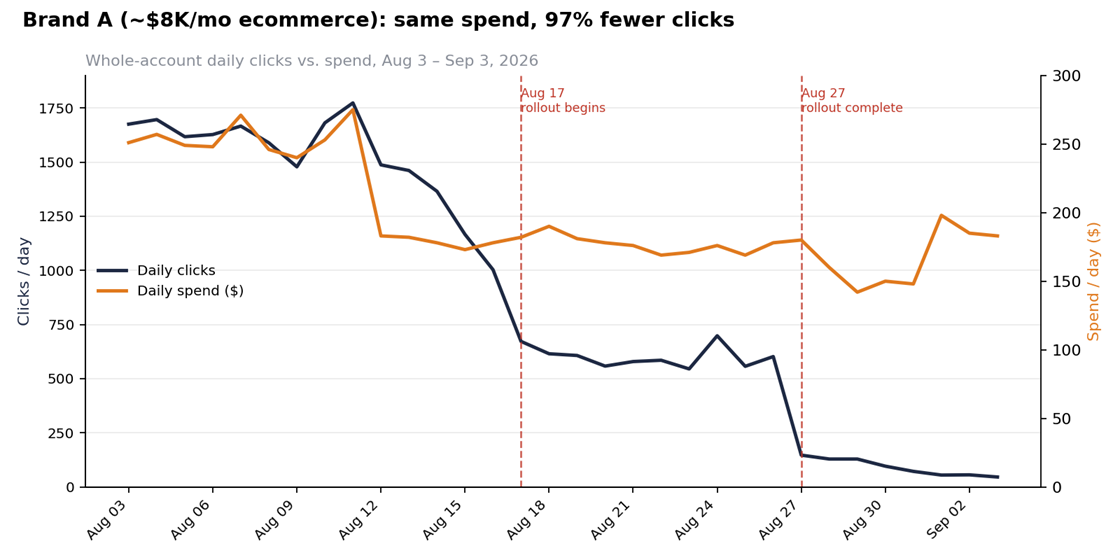
Note the spend dip on Aug 12: the client trimmed budget about 30% that week, and clicks softened slightly in response. Then Aug 17 hit and clicks fell off a cliff at the new spend level. Budget cuts don’t do that. Bidding changes do.
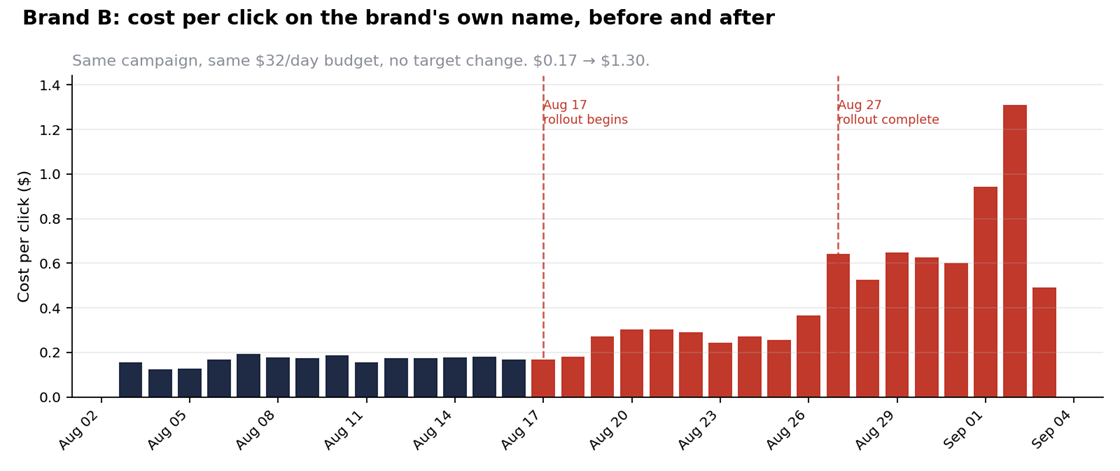
A ~$25K/month ecommerce account (Brand B), Search campaign, $32/day, ~45% budget-limited before the change. Daily clicks held at 175–215 through Aug 18, dropped to 105–125 on Aug 19, then to 25–60 from Aug 27 on. Spend never moved. The effective CPC on the brand’s own name went from $0.17 to $1.30. Weekly revenue from that campaign went $24.3K → $26.6K → $16.0K → $12.3K.
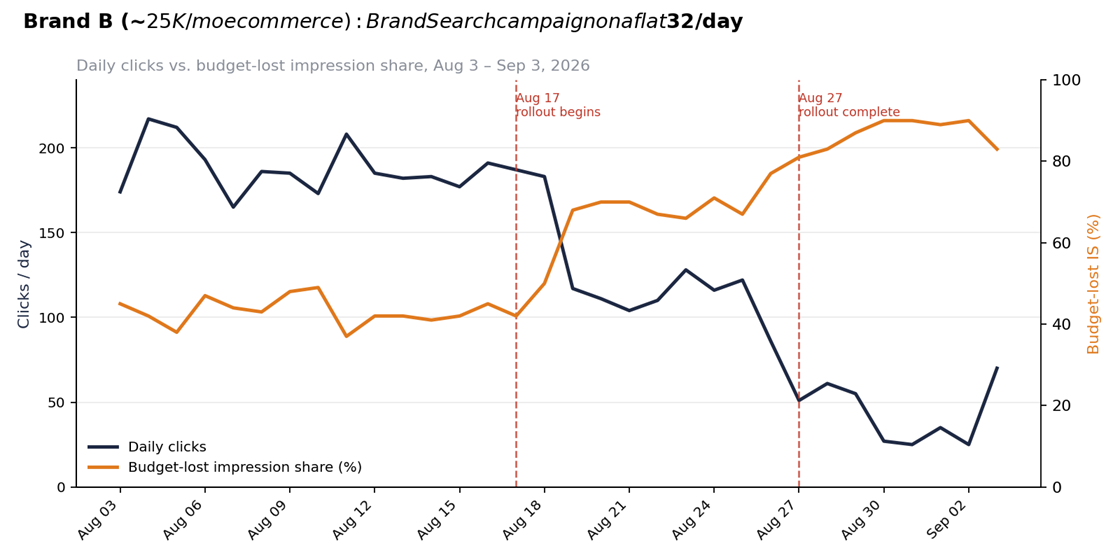
The same shape shows up everywhere we look at a capped target campaign:
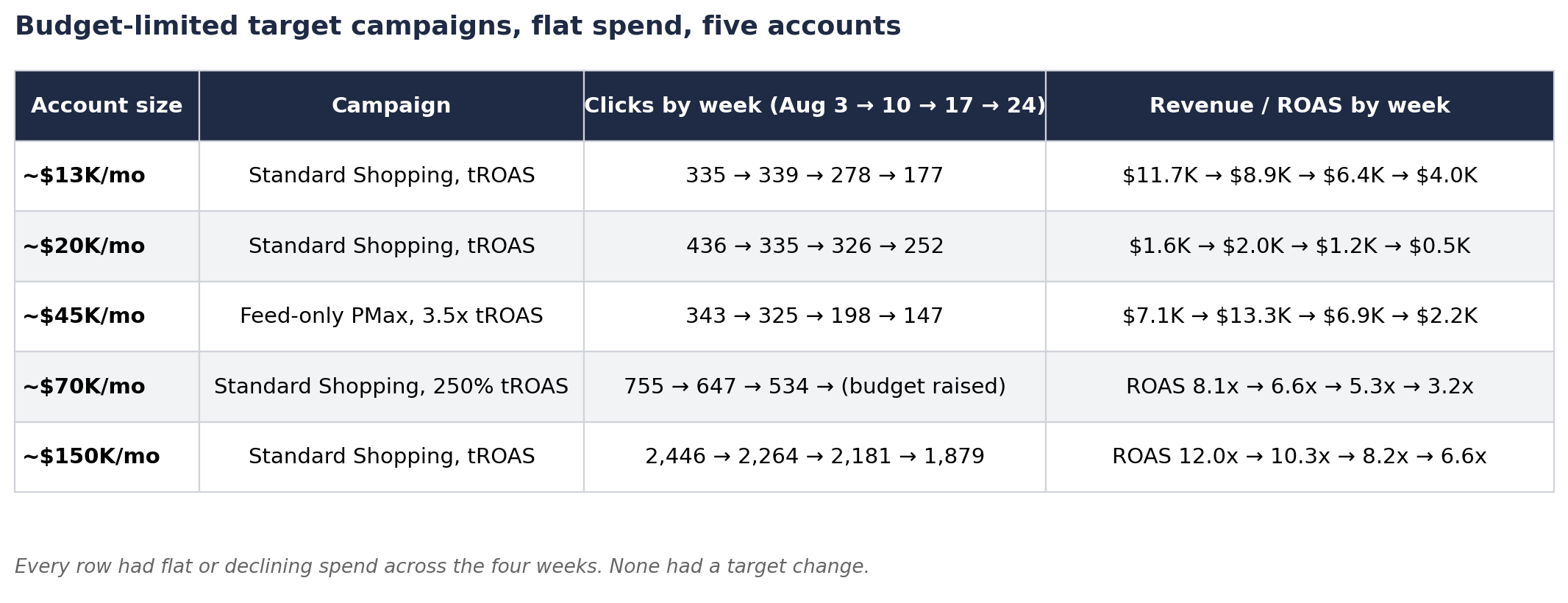
Every one of those had flat or declining spend across the four weeks. None had a target change.
Finding 2: Campaigns that weren’t budget-limited became budget-limited overnight
Wait, what? This was the result we didn’t see coming. Dozens of campaigns that were sitting at 2–30% budget-lost impression share before Aug 17 jumped to 60–90% the week of Aug 17, with no budget change and no target change.
A few examples, all Performance Max on tROAS, budget-lost IS by week:
- ~$45K/mo account, product-line campaign A: 2% → 5% → 45% → 66%
- ~$45K/mo account, feed-only campaign B: 28% → 43% → 85% → 90%
- ~$20K/mo account, hero-products campaign: 3% → 2% → 25% → 55%
- ~$25K/mo account, high-index products: 3% → 5% → 31% → 65%
- ~$13K/mo account, both prospecting campaigns: 13% → 9% → 63% → 90% and 43% → 30% → 81% → 90%
- ~$100K/mo account, category PMax: 5% → 12% → 55% → 70%
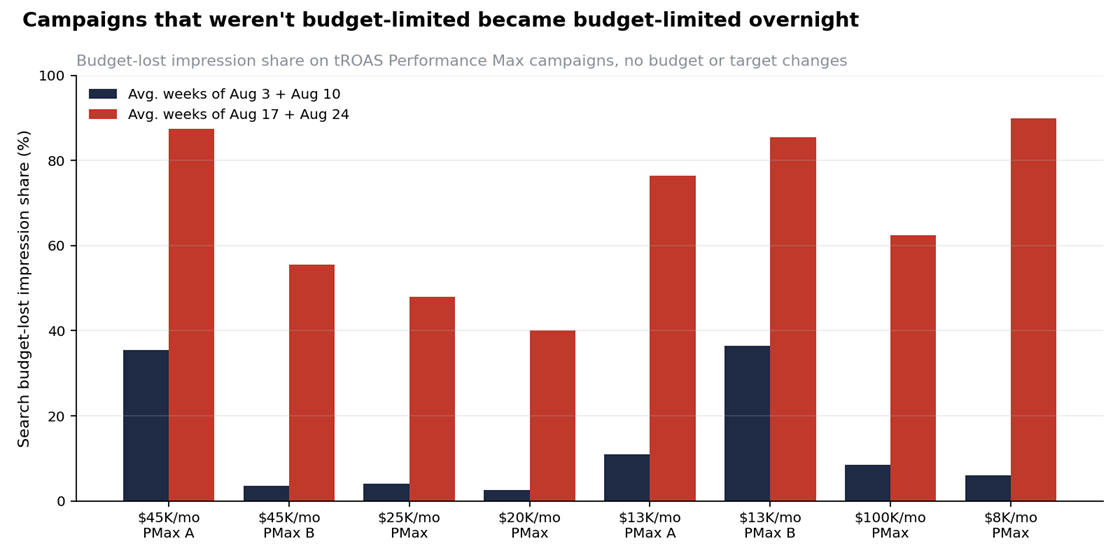
What this looks like in practice: the new logic bids up to the stated target on every auction, spends the daily budget by early afternoon, and then goes dark. Google’s very own help doc says campaigns will “more consistently perform toward your bid target.” What that means in reality is the campaign will stop cherry-picking cheap conversions and starts paying full freight for every one, which burns through a small budget fast.
If your campaign was close to its cap before Aug 17, I will bet you are almost certainly hard-capped now, whether or not you changed anything.
Finding 3: It’s the bidding strategy, not the budget cap
The cleanest evidence we see, that this is a bidding-logic change (and not seasonality, competition, or something we did) comes from campaigns sitting side by side in the same account.
A ~$70K/month ecommerce account runs a Manual CPC campaign that is 65–70% budget-limited, right next to a Target ROAS Shopping campaign that is 80–90% budget-limited. Same brand, same products, same weeks:
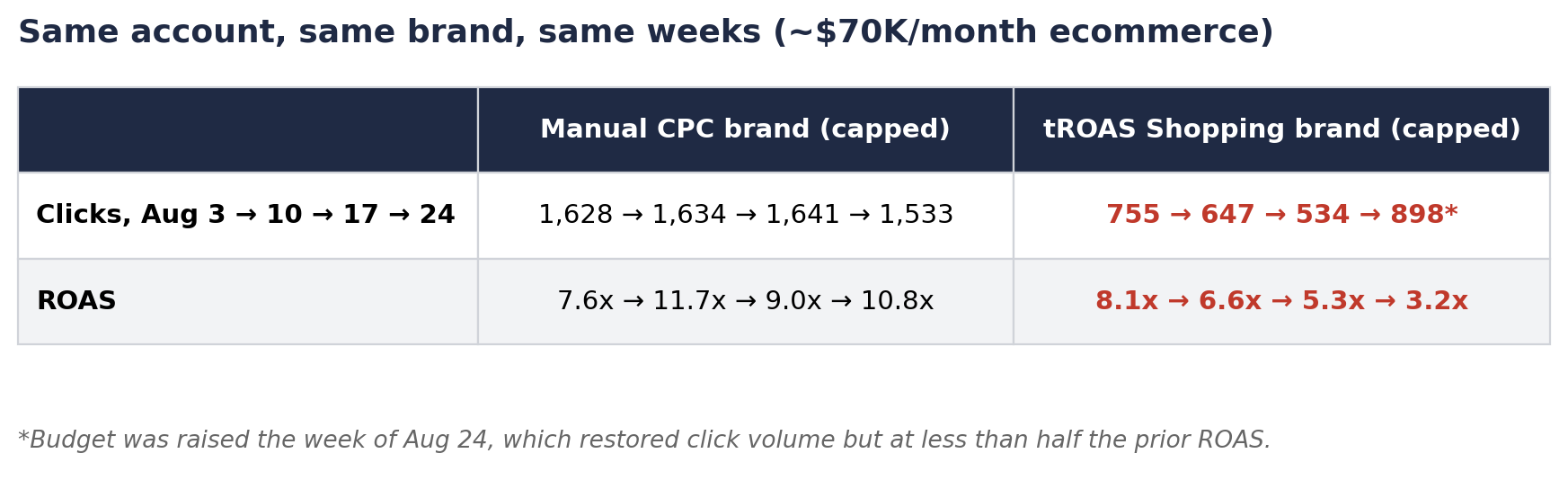
*Budget was raised the week of Aug 24, which restored click volume but at less than half the prior ROAS.
The Manual CPC campaign did not notice the change. The tROAS campaign beside it however, lost 30% of its clicks and 35% of its efficiency before the budget was ever touched.
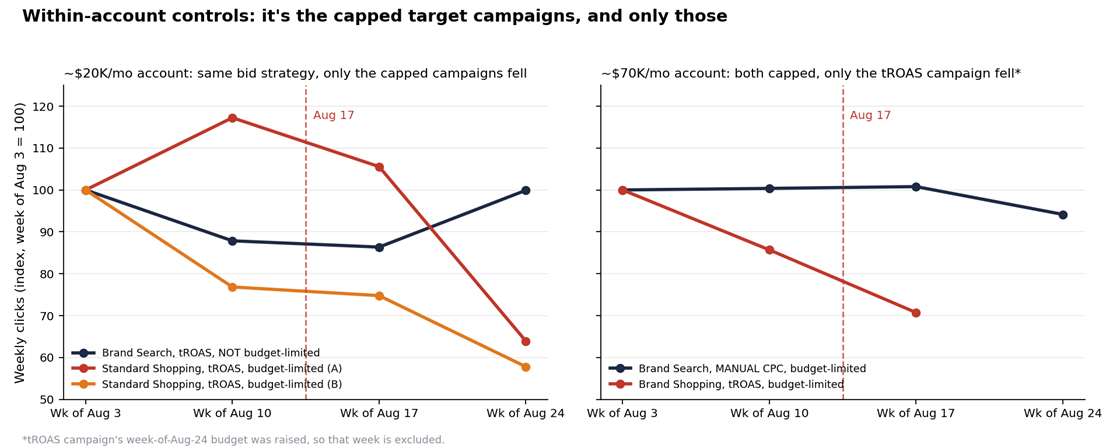
A ~$20K/month ecommerce account gives the same picture from the other direction. Its unconstrained Brand Search campaigns dipped the week of Aug 17 and rebounded the week of Aug 24 (1,202 → 1,056 → 1,038 → 1,201 clicks). All of the budget-limited Shopping and PMax campaigns in the account kept sliding. The unaffected campaigns and the affected campaigns shared the same seasonality, the same site, the same feed. The only difference was whether they were capped on a target strategy.
Five large accounts (all with near-zero budget-lost impression share) showed nothing at all. That is exactly what Google said would happen, and it’s the strongest reason to believe the damage on the capped campaigns is real. This also raises the question, what is going to happen to the “little-guy” accounts, that can’t afford to have uncapped budgets?
Finding 4: Phase two was so much worse than phase one
On nearly all of our affected campaigns the week of Aug 24 was clearly worse than the week of Aug 17, and the first week of September is showing signs of being worse again. Two things are going on.
First thing to remember, Google’s rollout wasn’t a single switch. The help center notes the change “rolled out globally” starting Aug 17 and was “completed on August 27.” All of our worst-hit accounts show a second, sharper step-down on Aug 27.
Second, the change compounds. Fewer clicks means fewer conversions, fewer conversions means weaker signal for the bidding model, weaker signal means worse bids. A campaign doing 200 conversions a week can absorb that. A campaign doing 20 can’t. This is the mechanism behind what we’ve been telling clients: on small budget-limited accounts, optimization has become close to impossible, because the system is now starving itself of the data it needs to optimize.
Why small accounts got hit hardest
Nothing in the data suggests Google will treat a $10K account differently from a $1M account. The change hits campaigns, not accounts. But the practical impact scales inversely with budget for three reasons:
- Coverage. In a $500K/month account, maybe 10–20% of campaigns are budget-limited, and the unconstrained majority absorbs the loss. In a $10K/month account, often everything is budget limited (Of course, they are a small brand who MUST control their spending). In these accounts, there is nothing to absorb anything.
- Signal. Small accounts have low conversion counts to begin with. Cutting clicks by 60–90% (Those CPC’s, I mean, wow) pushes most campaigns below the volume Smart Bidding needs to function, which triggers the drop described above.
- Targets. Small accounts are the ones most likely to have been running “aspirational” targets: a 6x tROAS on a campaign that had been quietly delivering 20x because budget forced it to be selective. Those are exactly the campaigns Google said it would pull back to target. It did, and then some.
Of the accounts we reviewed under $25K/month, every one running capped target campaigns was materially worse off after Aug 17.
What we’re doing about it
Uncap or re-target. Pick one. Google is now bidding to your stated target, so the target has to be real. Either raise the budget to the point where the campaign is no longer limited (and accept that it will spend to target), or use the Bid Target Adjustment Tool to set the target to what the campaign was actually achieving. Leaving a capped campaign on an old target is the worst of both worlds.
On Brand B, the brand campaign budget was raised from $32/day to ~$180 on Sep 4. It immediately did 299 clicks with 0% budget-lost impression share. Volume came back. CPC settled at $0.61, still 3.5x what it was in early August, but a long way from the $1.30 it hit under the cap.
Move brand campaigns off target bidding. Brand terms are where the “quietly over-delivering” effect was strongest, because the campaign could sit at a low budget and only pay for the cheapest, highest-intent clicks. That’s gone. Manual CPC and Target Impression Share were untouched across every account we looked at. For a capped brand campaign, either of those is now a safer default than tROAS.
Watch CPC, not spend. Spend looks normal. Impression share was already limited. The metric that actually moved is cost per click, and it moved 3–25x on the worst campaigns. If you only check budget pacing you will miss this entirely.
Be careful cutting budgets into it. One of our larger accounts reduced budgets across the board the week of Aug 17 for unrelated reasons. That pushed a dozen previously-unconstrained tROAS campaigns into “limited by budget” at the exact moment the new logic went live. Its main Shopping campaign went from 4,764 clicks to 850 in three weeks. If you need to reduce spend, re-target first if you can, then cut.
The caveats
This is observational data from our agency’s own book, not a controlled experiment. Late August carries its own seasonality for some verticals, and we excluded accounts where a promotion, budget change, or tracking issue landed in the same window. Conversion values for the most recent weeks are still maturing, so the revenue declines in the week of Aug 24 and after are somewhat overstated by attribution lag. Clicks and CPC, which don’t lag, tell the same story.
We also can’t see inside Google’s bidding model. What we can see is that campaigns matching Google’s stated criteria (target-based, limited by budget) behaved one way starting Aug 17, campaigns not matching those criteria behaved another way, and the divergence lines up with both dates Google published for the rollout.
Google framed this as a predictability improvement. For unconstrained campaigns, it probably is. For capped campaigns on small budgets, it has been the most damaging platform change we’ve seen in years, and the fix is on the advertiser to make.


%201.png)